
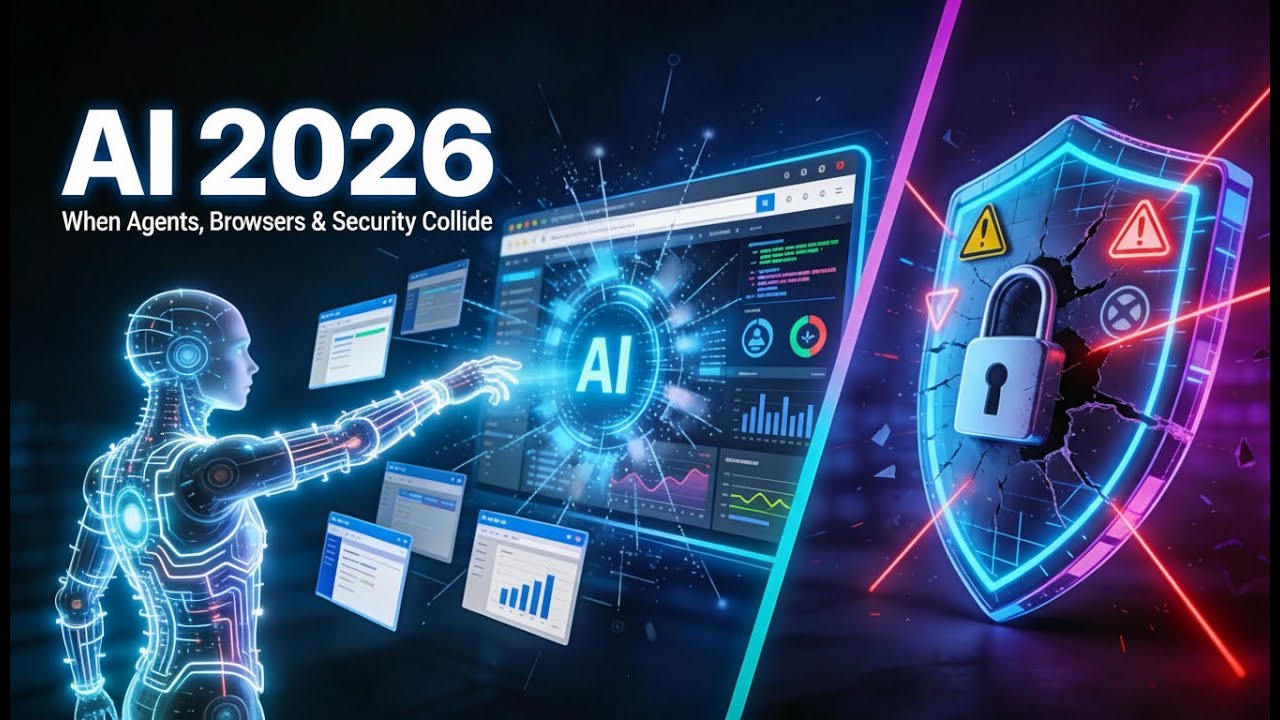
AI 20This episode is a fast-paced year-in-review on AI, knowledge work, and what 2026 will really look like for IT pros and enterprises, featuring us (James O’Regan and Gerjon Kunst) in conversation with futurist Brian Madden from Citrix.
1. Introduction
In this special end‑of‑year edition of “Impact of AI: Explored,” we invited our friend Brian Madden back for a 2025 wrap‑up and a look ahead to 2026. Brian joined us fresh from his new role as VP, Technology Officer & Futurist at Citrix, where he spends his time mapping how AI will reshape knowledge work and secure digital workplaces.
The conversation ranges from agentic AI and AI browsers to enterprise security, worker productivity, and whether we’re heading toward an AI market crash or an “iPhone moment” for AI. Along the way, we compare our 2024 predictions with what actually happened and share honest lessons learned from living at the edge of the AI/EUC world this year.
2. Meet the Guest
Brian Madden is a long‑time authority in end‑user computing and digital workspaces, with more than 30 years of experience as an analyst, author, founder, and speaker. He’s best known for creating BrianMadden.com and the BriForum conference, writing six books, publishing over 2,000 articles, and delivering more than 1,000 talks around the world on EUC and the future of work.
Today Brian is VP, Technology Officer & Futurist at Citrix, where he connects the dots between AI, secure workspaces, and how knowledge workers actually get things done. Before that he served as a Distinguished Technologist in VMware’s EUC Office of the CTO and has advised or invested in several startups.
3. Setting the Stage
AI moved from “nice demo” to “everyday tool” for knowledge workers in 2025, but most enterprises are still wrestling with basics like logons, profiles, and app performance while AI races ahead. The gap between frontier AI (agents, MCP, AI browsers) and what regular workers actually use (email help, basic drafting) is widening, and that tension is exactly where this episode lives.
Listeners can expect a grounded, EUC‑centric view on what’s hype and what’s real: why agentic AI didn’t quite own 2025, why AI browsers might define 2026, and how IT departments will be forced to care about AI usage they don’t control. We also dig into worker behavior (what people really do with “extra” AI time), enterprise security gaps, and why an AI market crash would not mean the end of AI.
4. Episode Highlights
- Highlight 1 – From “Year of Agents” to “Dawn of Agents”
At the end of 2024 we predicted 2025 would be the year of agentic AI, but in hindsight it was more like the dawn of agentic AI. Brian walks through OSWorld benchmarks, explaining how the best computer‑using agents have jumped from around 40% to 76% task success—now beating the median human at 72%—yet remain impractical for most workers.
“Just because the AI can use a computer as well as a human doesn’t mean all our jobs are replaced; it still needs humans to direct it.”
- Highlight 2 – Workers quietly take back their time
At Microsoft Ignite, Citrix ran a booth survey asking IT pros what they’d do with an extra hour a day saved by AI, and the top answer by far was “take back personal time.” Brian’s blog post title captured it perfectly: “IT admits workers are in charge of AI; workers admit they use it to go home at five.”
“We’ve been told to ‘do more with less’ for years. Now AI finally lets people stop working all night on expense reports.”
5. Deep Dive – Agentic AI and the Future of Work
The central thread of this episode is agentic AI: AIs that don’t just answer prompts, but take actions using your tools—browsers, desktops, and apps—on your behalf. Brian’s seven‑stage roadmap for human–AI collaboration runs from basic prompting to AI using your computer unsupervised and eventually orchestrating work with other agents, and he argues we’re now entering the “AI uses your computer for you” and early multi‑agent phases.
Despite massive technical progress, adoption is uneven. Most knowledge workers still use AI largely to help with emails and writing, while a small group of “nerds” automates whole chunks of their jobs with tools like n8n—just as they once did with PowerShell. Enterprise IT, meanwhile, is still focused on “boring fundamentals” like logon times and app performance, with AI mostly showing up as coding copilots and simple chatbots rather than fully agentic workflows.
Brian expects 2026 to be the moment when IT departments finally wake up to the business impact of uncontrolled agents and AI usage. Instead of worrying only about AI FOMO (“we don’t want to be the Blockbuster in the Netflix documentary”), they’ll have to confront real questions: Who’s responsible for what an agent does? How do you differentiate human actions from AI actions? What guardrails are necessary when workers privately orchestrate their own agents?
6. Real-Life Stories & Examples
- Ignite, AI, and the “walk‑the‑dog copilot”
Brian shares how the Microsoft 365 Copilot mobile app, tied into the full Microsoft Graph, has quietly become his walking assistant. On dog walks he talks through his calendar, triages mail, and flags emails with his earbuds—no Outlook or Teams UI in sight—illustrating his belief that in future we’ll talk to AI, and AI will talk to apps and data on our behalf. - AI browsers: from Nike sneakers to Office 365 access
Gerjon describes using AI browsers like Comate/Atlas to search for black Nike sneakers, add the cheapest ones to a basket, and receive a mobile notification when the purchase is ready to confirm. The same pattern—handing over credentials—could let an AI browser log into Office 365, set appointments, and do “a gazillion other things” inside the corporate environment, for good or for harm. - Raspberry Pi as a rogue “AI docking station”
To underline the limits of endpoint security, Brian explains how a Raspberry Pi can impersonate a keyboard, mouse, and monitor over USB and HDMI, effectively turning an AI running on the Pi into an invisible operator of a locked‑down corporate laptop. To the endpoint it looks like a normal docking station; to the attacker or power user, it’s an AI‑driven control surface bypassing conventional endpoint analytics. - The AI bubble that doesn’t kill AI
We also talk about the likelihood of an AI market correction, drawing parallels to the dot‑com bust and early failed bets like pets.com. Brian’s point: even if valuations collapse and many “ChatGPT wrappers” die, AI will continue to reshape knowledge work—just as the internet survived the dot‑com crash and now underpins everything.
7. Key Takeaways
- Agentic AI has crossed human‑level benchmarks for computer use, but is still early in terms of practicality and mainstream adoption.
- 2025 was the dawn of agentic AI, not its final form; 2026 will likely bring an overload of “agentic everything” offerings.
- Workers primarily use AI to reclaim personal time, not to double their workload, challenging management assumptions about “productivity gains.”
- AI browsers and local AI tools are a productivity dream and a security nightmare, especially when they’re given corporate credentials.
- Enterprise browsers (Edge for Business, Chrome Enterprise, etc.) and VDI are becoming essential front‑gate controls in an AI‑driven world.
- Most enterprises still focus on basic IT hygiene; AI is currently bolted on via coding copilots and chatbots, not deeply embedded agents.
- The future enterprise AI landscape will be multi‑agent and multi‑model, with internal agents (e.g., Microsoft WorkIQ‑style concepts) mediating access to sensitive data rather than dumb connectors.
- An AI market crash would not invalidate the technology; even with fewer vendors and lower valuations, AI will keep getting cheaper, more efficient, and more embedded in daily work.
8. Closing Thoughts
Recording this episode reinforced how fast AI is moving at the frontier, and how slowly organizations and workflows actually change. The next year will be less about a single “AI revolution” moment and more about a steady evolution: agents getting more capable, AI browsers entering the mainstream, IT finally putting real guardrails in place, and workers quietly reshaping their day with AI one task at a time.
We plan to make this year‑in‑review with Brian a recurring tradition for as long as it stays fun and people keep listening. If you have your own agentic AI stories, AI browser war stories, or predictions for 2026 and beyond, share them with us—we’d love to feature community perspectives in future episodes of “Impact of AI: Explored.”
